

Menu
About Addiction
Understanding Addiction
According to the World Health Organization, addiction is a condition that develops as a consequence of repeated substance use, involving a cluster of behavioural, cognitive, and physiological changes. It is characterised by a persistent urge to use the substance, an impaired capacity to control its use, continuation of use despite evident harm, a growing prioritisation of the substance over other responsibilities and relationships, increased tolerance, and, in many instances, physical withdrawal upon cessation.
In essence, addiction is not confined to a single symptom or isolated incident. It represents a progressive pattern that develops over time and affects the individual across physical, psychological, and behavioural dimensions simultaneously.
Clinically, the ICD (International Classification of Diseases) refers to this pattern as dependence, confirmed when at least two of the following are present: difficulty controlling use, the substance taking priority over other areas of life, and physical signs like tolerance or withdrawal.
It’s worth noting that doctors now recognise substance use on a spectrum — from risky patterns that haven’t caused harm yet, to full dependence — rather than treating it as an all-or-nothing issue.
The Physical and Mental Nature of Addiction
Addiction operates on two interconnected levels: a physical reaction within the body, and a mental pattern that overrides the will to stop. Understanding both is essential to understanding why addiction cannot be resolved through willpower alone.
The Physical Dimension: An Abnormal Reaction
For most people, the body processes alcohol at a steady, predictable rate, breaking it down until it is fully cleared from the system. In a person with alcoholism, however, repeated heavy drinking causes the body to adapt — it becomes more efficient at breaking alcohol down, so larger amounts are needed over time to produce the same effect. This growing tolerance is part of what drives escalating drinking: a person may start with a small, occasional amount, but as the body adjusts, that same amount no longer has the same effect, pushing consumption higher and higher — often far beyond what was originally intended. The same underlying pattern — the body adapting and demanding more over time — is also seen with other addictive substances, even though the specific chemistry differs from one to another.
The Mental Dimension: The Breakdown of Willpower
Alongside this physical reaction runs a parallel mental pattern. Emotional states such as fear, discontentment, restlessness, and irritability build over time, creating an inner pressure. Below a certain threshold, this pressure remains manageable. Beyond it, however, the mind begins to seek relief — and for someone with addiction, that relief becomes strongly associated with using the substance again.
At this point, even a firm, genuine resolve to stay away from the substance can be overridden. The mind convinces the person that “just one” will bring ease or resolve the discomfort — a conviction that feels entirely rational in the moment, despite prior experience suggesting otherwise.
A Self-Reinforcing Cycle
Together, these two dimensions form a cycle that sustains addiction over time: rising emotional discomfort feeds the mental obsession, the obsession leads to that “one” use, and because the body has adapted to need more for the same effect, that use often escalates well beyond what was intended — resulting in loss of control. This is often followed by remorse and renewed fear, which, left unaddressed, feeds the same emotional pressure that started the cycle again. This pattern echoes what the Big Book of Alcoholics Anonymous describes as a vicious cycle, in which physical craving and mental obsession continually reinforce one another.

This is precisely why recovery requires more than willpower or good intentions. Because the cycle operates on both a physical and a mental level simultaneously, effective treatment must address both — through medical support for the physical craving, and through therapeutic and emotional support for the underlying obsession and emotional triggers that drive it.
How Alcohol Is Metabolised: A Comparative Look
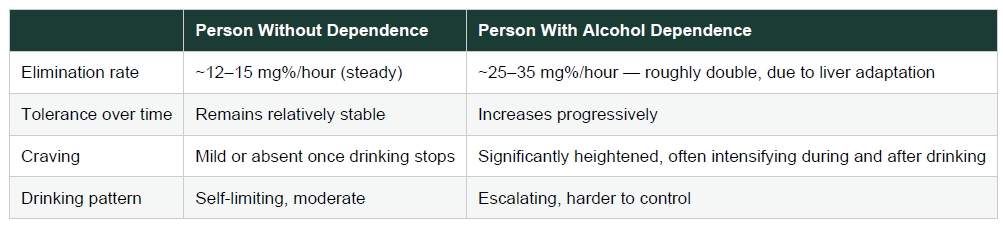
On average, a healthy person’s body breaks down alcohol at a fairly steady rate — roughly half a standard drink per hour — through a two-step process in the liver that eventually turns it into harmless water and carbon dioxide. This steady pace is why moderate drinking usually doesn’t lead to serious intoxication in someone without alcohol dependence.
In people with long-term, heavy alcohol use, the liver adapts over time and starts breaking down alcohol faster than normal — research suggests roughly double the rate of a non-drinker. This might sound like a good thing, but it isn’t —it’s actually part of the problem. As the body gets more efficient at processing alcohol, it takes larger amounts to feel the same effect, which is exactly what drives the increasing tolerance seen in alcohol dependence. This same adaptation is also linked to a significantly heightened craving response once drinking begins. Over time, this combination makes it easier to drink more, and harder to stop.
How Tolerance Develops with Drugs
The same underlying process seen with alcohol — the body adapting to a substance over time — applies broadly to other addictive drugs as well, even though the specific chemistry differs from one substance to another. With repeated use, the brain adjusts to the presence of the substance, becoming less responsive to it. As a result, the person needs progressively larger amounts to achieve the same effect they once felt with a smaller dose. This adaptation is a core reason why addiction escalates over time rather than staying constant. What may begin as an occasional, moderate amount often increases steadily, not necessarily because the person is choosing to use more, but because their body genuinely requires more to feel the same relief or effect. This is precisely why addiction cannot be resolved through willpower alone — the body itself is driving part of the escalation.
Why Overdose Risk Increases Over Time
A common misconception is that becoming more “experienced” with a substance makes a person safer from overdose. In reality, the opposite is often true, and understanding why is important. As tolerance builds, it typically builds unevenly — tolerance to the pleasurable or desired effect of a substance tends to increase faster than tolerance to its dangerous effects, such as its impact on breathing or heart function. This means a person may need to take significantly more of a substance to feel the same high, while their body’s ability to tolerate that same larger amount safely has not increased nearly as much. The gap between these two grows over time, which is a key reason overdose risk tends to rise the longer addiction continues, rather than decrease with experience.
This is also why overdose should always be treated as a medical emergency requiring immediate attention, not as a reflection of carelessness or personal failure.
Given how much the body comes to depend on a substance through this process, it follows that removing that substance suddenly — rather than gradually and under supervision — carries its own serious risks. This understanding matters because it becomes easier to see why addiction is discussed in the same terms as other chronic medical conditions, rather than as a simple matter of habit or choice.
Habit or Disease?
Addiction is often mistaken for a bad habit that can be fixed with enough willpower. Unlike a habit, addiction involves measurable changes to the brain’s reward, motivation, and impulse-control systems, driving compulsive use even when a person genuinely wants to stop. This is why the World Health Organization and major medical bodies classify addiction as a chronic disease of the brain, not a behavioural habit. As the section below shows, the physical evidence behind this classification is well documented.
The Physical Evidence: What Scans and Tests Reveal
Prolonged alcohol and substance use cause measurable damage across multiple organs, often detectable through medical imaging and standard tests, offering concrete evidence that addiction is a physical condition, not simply a matter of choice.
• Brain — MRI and PET scans of individuals with long-term addiction frequently show reduced activity in areas responsible for judgment, self-control, and reward processing, along with visible brain shrinkage (atrophy) in some cases — changes that can persist even after a person stops using.
• Liver — Long-term alcohol use can cause fatty liver, inflammation, and scarring (cirrhosis), often visible on ultrasound or other liver imaging, along with abnormal results on routine liver function blood tests.
• Heart — Prolonged heavy alcohol or stimulant use can weaken the heart muscle over time, a condition that can be identified through echocardiograms and other cardiac imaging.
• Pancreas — Chronic alcohol use is a leading cause of pancreatitis (inflammation of the pancreas), which can be detected via imaging and blood tests, and can cause lasting damage to digestion and blood sugar regulation.
• Nervous system — Long-term substance use can damage peripheral nerves, leading to numbness, tingling, or weakness in the hands and feet — a condition that can be confirmed through nerve conduction studies.
• Blood tests — Routine bloodwork often reveals the impact of long-term substance use even before symptoms appear, including abnormal liver enzymes, changes in red blood cell size, and nutritional deficiencies common in long-term addiction.
This is precisely why willpower alone cannot “undo” addiction: by the time these physical changes have developed, they require actual medical healing and recovery time, much like any other injury or disease would.
What Is a Chronic Disease?
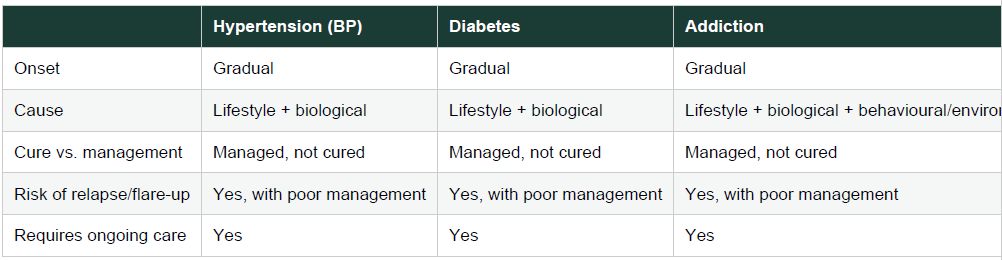
A chronic disease is a long-term condition that develops gradually and persists over time — typically not “cured” outright, but managed through consistent treatment and lifestyle adjustments, the way diabetes is managed through medication, diet, and monitoring rather than willed away. Addiction follows this same pattern: it builds gradually, cannot be resolved through willpower or a single decision, requires ongoing care such as medical support and counselling, and carries a real risk of relapse after a setback — a setback that, as with diabetes, reflects the chronic nature of the condition rather than personal failure.
Lifestyle Factors
As with hypertension and diabetes, lifestyle plays a significant role in both the development and management of addiction — recovery, like management of any chronic disease, benefits significantly from broader lifestyle changes and not just clinical treatment alone.
What Is Detox?
Detoxification (detox) is the medically supervised process of allowing the body to safely eliminate a substance and stabilise after a period of regular use.
Importantly, detox is only the first stage of treatment — it addresses the physical presence of the substance in the body, but not the underlying psychological and behavioural patterns of addiction. This is why detox alone, without follow-up counselling and support, has a high likelihood of relapse.
Stopping a substance abruptly and without medical support — commonly called going “cold turkey” — is often seen as a straightforward or even admirable way to quit. In reality, whether this is safe depends entirely on the substance involved. For alcohol and benzodiazepines, it’s specifically avoided, since sudden withdrawal can trigger seizures and delirium tremens, both of which can be fatal without medical treatment — which is why these substances are tapered gradually under supervision instead.
Not all withdrawal is equally dangerous, but a few categories carry serious, well-documented risk:
• Alcohol — Withdrawal from long-term, heavy alcohol use is considered the most dangerous of all, and is the most common cause of death from withdrawal generally. In severe cases, it can lead to seizures and a condition called delirium tremens (DTs) — marked by severe confusion, hallucinations, and dangerous instability in heart rate and blood pressure. Without medical treatment, this can be fatal.
• Benzodiazepines (such as certain anti-anxiety or sleep medications) — Withdrawal carries similar risks to alcohol, including the possibility of severe, life-threatening seizures, particularly after long-term or high-dose use.
By contrast, withdrawal from substances such as opioids, stimulants, or nicotine is typically extremely uncomfortable and distressing — but rarely fatal on its own in an otherwise healthy person. That said, indirect complications, such as severe dehydration from vomiting, can still pose real health risks, which is another reason supervised care matters even for withdrawals that aren’t considered directly life-threatening.
Co-morbidity: When Addiction Doesn’t Occur Alone
Co-morbidity refers to the presence of one or more additional conditions occurring alongside a primary diagnosis. In the context of addiction, this frequently means the coexistence of substance use with other physical or mental health conditions — such as liver disease, cardiovascular issues, anxiety, depression, or other psychiatric conditions.
Recognising co-morbidity matters because treating addiction in isolation, without addressing accompanying conditions, often leads to incomplete recovery.
Stressful life events — such as grief, job loss, or relationship breakdown — can play a genuine role in the onset or worsening of these co-occurring conditions. However, reacting to a stressful event on its own does not meet the diagnostic criteria for a mental health or substance use disorder; a diagnosis requires a persistent pattern of symptoms, not simply a difficult reaction to a difficult moment.
Mental Illness as an Underlying Cause
In many cases, addiction does not arise in isolation — it can be closely linked to an underlying, sometimes undiagnosed, mental health condition. Individuals may turn to substances as a way of coping with anxiety, depression, trauma, or other psychological distress, using the substance’s temporary relief as a form of self-medication.
This relationship works both ways: mental illness can contribute to the development of addiction, and prolonged substance use can, in turn, worsen or trigger mental health conditions. This is why a thorough psychological assessment is a critical part of addiction treatment — without identifying and addressing an underlying mental health condition, treating the addiction alone often fails to resolve the deeper issue driving it.
Natural Reward Pathways and the Stigma Around Treatment
Addictive patterns are not limited to substances. The brain’s reward system can also be hijacked by certain behaviours — gambling, compulsive sexual behaviour, and excessive social media use among them — because these activities trigger the release of the body’s own natural opioids and dopamine, producing a rewarding sensation similar to that caused by drugs. The word “endorphin” itself reflects this mechanism — it comes from “endogenous” (produced within the body) and “morphine,” since these natural chemicals act on the same receptors as opioid drugs. This shared mechanism is precisely why these behaviours can spiral into genuine, harmful addictions for some people, not because the reward itself is harmless, but because the same brain circuitry that drives substance addiction is at work.
Despite this shared biological basis, substance addiction specifically tends to carry a heavier stigma, while behavioural addictions like these are often dismissed as “bad habits” rather than recognised as serious conditions in their own right. Seeking treatment for substance use is sometimes still viewed as taboo in a way these other compulsive behaviours are not — even though both can cause comparable harm to a person’s health, relationships, and functioning.
Myths vs. Facts About Addiction
Myth: Addiction only happens to people who lack willpower or good values.
Fact: Addiction is a medical condition involving changes to brain chemistry. It affects people across all backgrounds, income levels, and personality types — willpower alone rarely resolves it, just as it wouldn’t resolve diabetes or hypertension.
Myth: A person has to hit “rock bottom” before they can be helped.
Fact: Recovery outcomes are generally better the earlier treatment begins. Waiting for a crisis point often means more damage has already been done — to health, relationships, and finances — that could have been avoided.
Myth: Only illegal drugs cause addiction.
Fact: Addiction can develop from legally prescribed medication, such as painkillers or sedatives, especially when taken over a long period without proper medical supervision.
Myth: Once someone becomes addicted, they can never fully recover.
Fact: Recovery is real and achievable. Like other chronic conditions, addiction requires ongoing management, but many people go on to lead stable, fulfilling lives with the right treatment and support.
Myth: If someone relapses, treatment has failed.
Fact: Relapse is a common part of the recovery process, not a personal failure or something to hide in shame. It doesn’t undo progress — it teaches what still needs attention, and signals a need to adjust the treatment approach.
Myth: Addiction is a private issue that only affects the person using the substance.
Fact: Addiction affects the entire support system around a person — family, friends, and close relationships all experience its impact, which is why treatment approaches often involve family support as well.
Myth: Cutting down or drinking in moderation is a realistic goal for someone with alcohol dependence.
Fact: Because of the loss of control described earlier, moderate drinking is generally not sustainable once dependence has developed. Complete abstinence remains the safest and most reliable path to lasting recovery — and treatment that leaves the family out of the process is often far less effective, since recovery is rarely sustained in isolation from the environment a person returns to.
The Impact on Families
Addiction rarely affects only the individual experiencing it — it reshapes the emotional and practical life of everyone close to them, often straining trust, finances, and family roles well before the person themselves acknowledges there is a problem.
Enabling and Codependency: How Family Patterns Can Work Against Recovery
Two related patterns are worth understanding here. Enabling refers to actions — often well-meaning — that shield a person from the natural consequences of their addiction, such as making excuses for them, covering financial costs tied to their use, or taking over responsibilities they’ve neglected. Codependency describes a broader pattern where a family member’s own emotional wellbeing becomes centered on managing, controlling, or protecting the person with addiction, often at the expense of their own needs.
Research has linked both patterns to worse outcomes — not just for the person struggling with addiction, but for the family itself — playing a role in prolonging the cycle of addiction rather than interrupting it. This is a key reason addiction treatment increasingly involves the family directly, rather than treating the addiction as the individual’s problem alone.
In many families, certain roles take shape well before addiction develops, occasionally rooted in childhood. One recognised pattern in recovery literature is “King Baby Syndrome” — a form of emotional immaturity marked by entitlement, difficulty handling criticism, and a persistent need for validation, often traced back to relationship dynamics where behaviour went without consequence early in life. Both before and after addiction develops, enabling and codependency can show up in similar ways: offering money, making excuses, or issuing warnings and consequences that are never followed through, sometimes called “empty threats.” Because family is always affected in some way, even indirect actions — such as lying or covering for the person to others — can unintentionally sustain the very behaviour the family is trying to stop. Recognising and removing these patterns is just as important as offering support itself.
It is important for families to understand that they are not the cause of someone’s addiction, nor are they solely responsible for fixing it — but their support, understanding, and involvement in treatment can meaningfully improve outcomes. In fact, recovery is rarely sustained in isolation: a person may stay sober for a period away from home, only to relapse once back in an unchanged family environment. Seeking guidance for themselves, whether through counselling or family support programs, is often just as important as the treatment the individual receives.
Complete Information About Addiction
An addiction is a habitual mental and physical dependence on a substance or practice beyond one’s voluntary control which is characterized by well-defined physiological symptoms upon withdrawal.
A person with addiction usually has 3 or more of the following:
Signs and Symptoms of Addiction:
- A tolerance for the substance or practice that requires increasing amounts to achieve the same effect.
- Strong cravings for the substance or practice.
- Being unable to stop using the substance or practice without going through withdrawal.
- Loss of control over frequency and amounts of drug or substance usage.
- Preoccupation with the substance or practice.
- Inability to meet obligations to family, job, or other personal interests because of the substance or practice.
- Physical or psychological deterioration due to use of the substance or practice.
Types of Addiction:
- Alcohol
- Illegal drugs
- Prescription drugs
Alcoholism
Alcoholism is a disease characterized by the habitual intake of alcohol. The definition of alcoholism is chronic alcohol use to the degree that it interferes with physical or mental health, or with normal social or work behavior.
Alcoholism is a disease that produces both physical and psychological addiction. Alcohol is a central nervous system depressant that reduces anxiety, inhibition, and feelings of guilt. It lowers alertness and impairs perception, judgment, and motor coordination. In high doses, it can cause loss of consciousness and even death. Alcoholism is a disease that damages the brain, liver, heart, and other organs.
Sign & Symptoms of Alcoholism
- Increasing tolerance to the effects of alcohol. You may have heard the expression that someone can “hold their liquor.” This is not a sign that this person will not have problems with alcohol; in fact, this may be an early sign of alcoholism as a disease.
- A growing preoccupation with or interest in drinking. Also drinking alone or drinking before an activity where there will be drinking. It may seem as though one simply enjoys drinking. We now know that these can be part of the definition of alcoholism.
- A person will dispute their drinking is a problem. This symptom, called denial, is almost always present in the disease of alcoholism.
- Later, difficulties in relationships, on the job, or with the law often occur.
- Hiding alcohol or sneaking drinks.
- Gulping the first few drinks.
- Wanting to drink more, or longer, than the rest of the crowd.
- Losing control of drinking, leading to attempts to control it.
Illegal Drugs
The epidemic of substance abuse in young generation has assumed alarming dimensions in India. Changing cultural values, increasing economic stress and dwindling supportive bonds are leading to initiation into substance use. Cannabis, Cocaine, Heroin, Methamphetamine, LSD, Opium, MDMA, DMT drugs are the most frequently abused drugs in India. Drug use, misuse or abuse is also primarily due to the nature of the drug abused, the personality of the individual and the addict’s immediate environment. Cannabis products, often called charas, bhang, or ganja, are abused throughout the country.
Sign & Symptoms of Illegal Drugs
Appearance:
- Dilated pupils
- Runny nose (snorting)
- Nosebleeds (snorting)
- Track marks (injecting)
- Burned lips or fingers (smoking)
Heart:
- Fast heart rate
- Constricted blood vessels
- Enlarged Heart
- Heart attacks
- Cardiac arrest
Mental State:
- Euphoria
- Overconfidence
- Unusual excitement
- Aggressiveness
- Paranoia
- Poor judgment
- Delusions
Prescription Drugs
Taking prescription drugs in a way that hasn’t been recommended by a doctor can be more dangerous than people think. In fact, it’s drug abuse. And it’s illegal, just like taking street drugs. Some people abuse prescription drugs because they think they will help them have more fun, lose weight, fit in, and even study more effectively. Prescription drugs are only safe for the people who have prescriptions for them. That’s because a doctor has examined these people and prescribed the right dose of medicine for their medical condition. The doctor has also told them exactly how they should take the medicine, including things to avoid while taking the drug. They also are aware of side effects and can watch patients closely for these.
The most commonly used prescription drugs fall into three classes:
1. Opioids
- Examples: oxycodone (OxyContin), hydrocodone (Vicodin), and meperidine (Demerol)
- Medical uses: Opioids are used to treat pain or relieve coughs or diarrhea.
- How they work: Opioids attach to opioid receptors in the central nervous system (the brain and the spinal cord), preventing the brain from receiving pain messages.
2. Central Nervous System (CNS) Depressants
- Examples: phenobarbital (Luminal), diazepam (Valium), and alprazolam (Xanax)
- Medical uses: CNS depressants are used to treat anxiety, tension, panic attacks, and sleep disorders.
- How they work: CNS depressants slow down brain activity by increasing the activity of a neurotransmitter called GABA. The result is a drowsy or calming effect.
3. Stimulants
- Examples: methylphenidate (Ritalin) and amphetamine/dextroamphetamine (Adderall)
- Medical uses: Stimulants can be used to treat narcolepsy and ADHD.
- How they work: Stimulants increase brain activity, resulting in greater alertness, attention, and energy.
What Are the Dangers of Abusing Medicines?
Like all drug abuse, using prescription drugs for the wrong reasons has serious risks for a person’s health.
Opioid abuse can lead to vomiting, mood changes, decrease in ability to think (cognitive function), and even decreased respiratory function, coma, or death. This risk is higher when prescription drugs like opioids are taken with other substances like alcohol, antihistamines, and CNS depressants.
CNS depressant abuse is risky too. Abruptly stopping or reducing them too quickly can lead to seizures. Taking CNS depressants with other medicines, such as prescription painkillers, some over-the-counter cold and allergy medicines, or alcohol can slow a person’s heartbeat and breathing — and even kill.
Stimulant abuse (like with some ADHD drugs) may cause heart failure or seizures. These risks are increased when stimulants are mixed with other medicines — even OTC ones like cold medicines. Taking too much of a stimulant can lead to a dangerously high body temperature or an irregular heartbeat. High doses over a short period may make someone aggressive or paranoid. Stimulant abuse might not lead to physical dependence and withdrawal, but users might take the drugs so often that they become a hard habit to break.
Important Note: Mehar Foundation currently operates from one exclusive and authorized branch located in Panchkula. To ensure quality care, confidentiality and ethical practices, we do not have any other branches, franchises or associate centers anywhere in India.
Mehar Foundation does not have any other branches, franchises or partner centers.

Mehar Foundation, an open rehab, is based on the principle that free will is essential for recovery from addiction.
Contact Us
Our Services
Quick Link
- Alcohol Rehab Centre in Ambala
- Alcohol Rehab Centre in Punjab
- De Addiction Rehab in Punjab
- Drug Rehab Centre in Punjab
- Best De Addiction Rehab in India
- Nasha Mukti Kendra in India
- Alcohol Rehab Centre in India
- Nasha Mukti Kendra in Patiala
- Nasha Mukti Kendra in Ludhiana
- Nasha Mukti Kendra in Parwanoo
Quick Link
- Open Rehab Centre in Chandigarh
- Open Rehab Centre in India
- Open Rehab Centre in Mohali
- Rehabilitation Centre in Chandigarh
- Drug Rehabilitation Centre in India
- Rehabilitation Centre in Punjab
- Nasha Mukti Kendra in Punjab
- Nasha Mukti Kendra in Chandigarh
- Alcohol Rehab Centre in Chandigarh
- De Addiction Centre in North India
- Drug Rehab Centre in North India
- De Addiction Centre in Chandigarh
- Drug Rehab Centre in Haryana
- Nasha Mukti Kendra in Haryana
- Alcohol Rehab Centre in Yamunanagar
- Nasha Mukti Kendra in Yamunanagar
- De Addiction Centre in Yamunanagar
- De Addiction Centre in Delhi
- Alcohol Rehab Centre in Delhi
- Nasha Mukti Kendra in Delhi
- Nasha Mukti Kendra in Ambala
- De Addiction Centre in Ambala
- Best Rehabilitation Centre in Patiala
- Best Rehabilitation Centre in Haryana
Copyright ©2023 All Rights Reserved | Mehar Foundation Managed by the Satya Rani Rampal Trust | Developed by Webmetasolutions.com